01 / Tasks
OETGBench
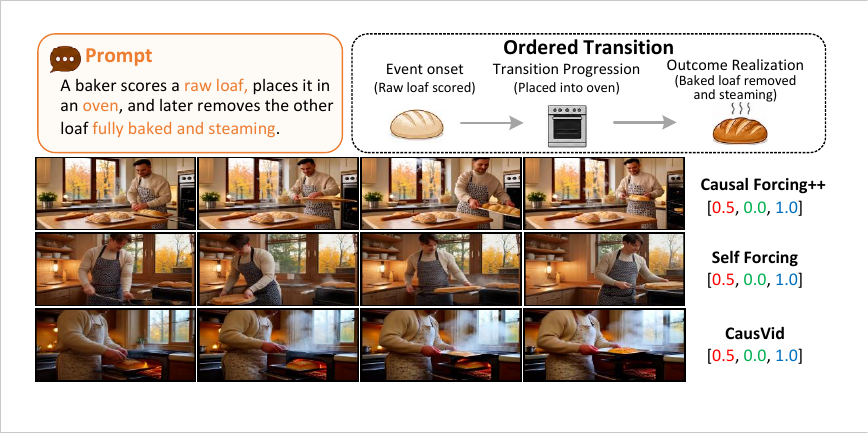
Original generation prompt
Initial state
Requested event transition
Target outcome
Requested event transition
Target outcome
OnsetProgressionOutcome
Phase-specific completion descriptions and evaluation questions
Ordered Event-Transition Generation
Benchmarking and Improving Ordered Event-Transition Generation in Few-Step Autoregressive Video Models
Anonymous research demonstration
Few-step autoregressive video generation has emerged as a promising paradigm for low-latency streaming synthesis, offering a practical foundation for interactive simulation, embodied agents, and real-time world models. However, these rollout-based distillation methods primarily optimize low-level denoising objectives or distribution matching with the teacher, rather than explicitly enforcing the correct temporal realization of requested event transitions.
We define an event transition as a temporally evolving and visually observable process through which a scene, entity, or interaction departs from an identifiable initial state, undergoes task-relevant intermediate changes, and establishes a target outcome.
The evaluation framework
Beyond prompts that clearly delineate event transitions, OETGBench provides phase-specific descriptions of successful completion and targeted quality-assessment questions to support fine-grained evaluation.
Original generation prompt
Phase-specific completion descriptions and evaluation questions
Frozen-base reference video
Task-matched anchor
LoRA optimization
Not post-update acceptance or rollback
Framework re-laid out for the web using the current manuscript terminology. Temporal Order describes coarse temporal compatibility across overlapping windows, not frame-exact ordering. VLD diagnostics and phase/order scores are reported separately.
Qualitative examples
The evaluated few-step autoregressive models can produce visually plausible videos while failing to faithfully realize the requested event transition.
Examples are intended to explain individual transitions and failure modes; selected cases are not estimates of category-level failure prevalence.
Inside the benchmark
Four task-oriented families organize the dominant requested change: Action Start, Entity Interaction, Object State Change, and Environmental Perturbation.
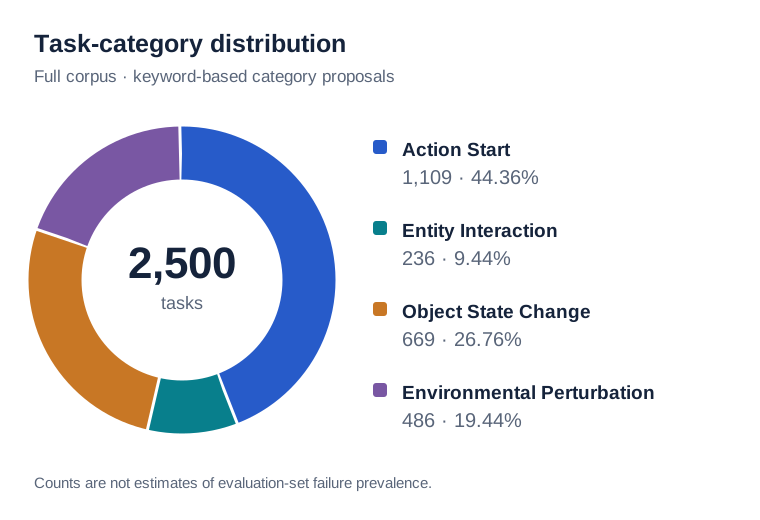
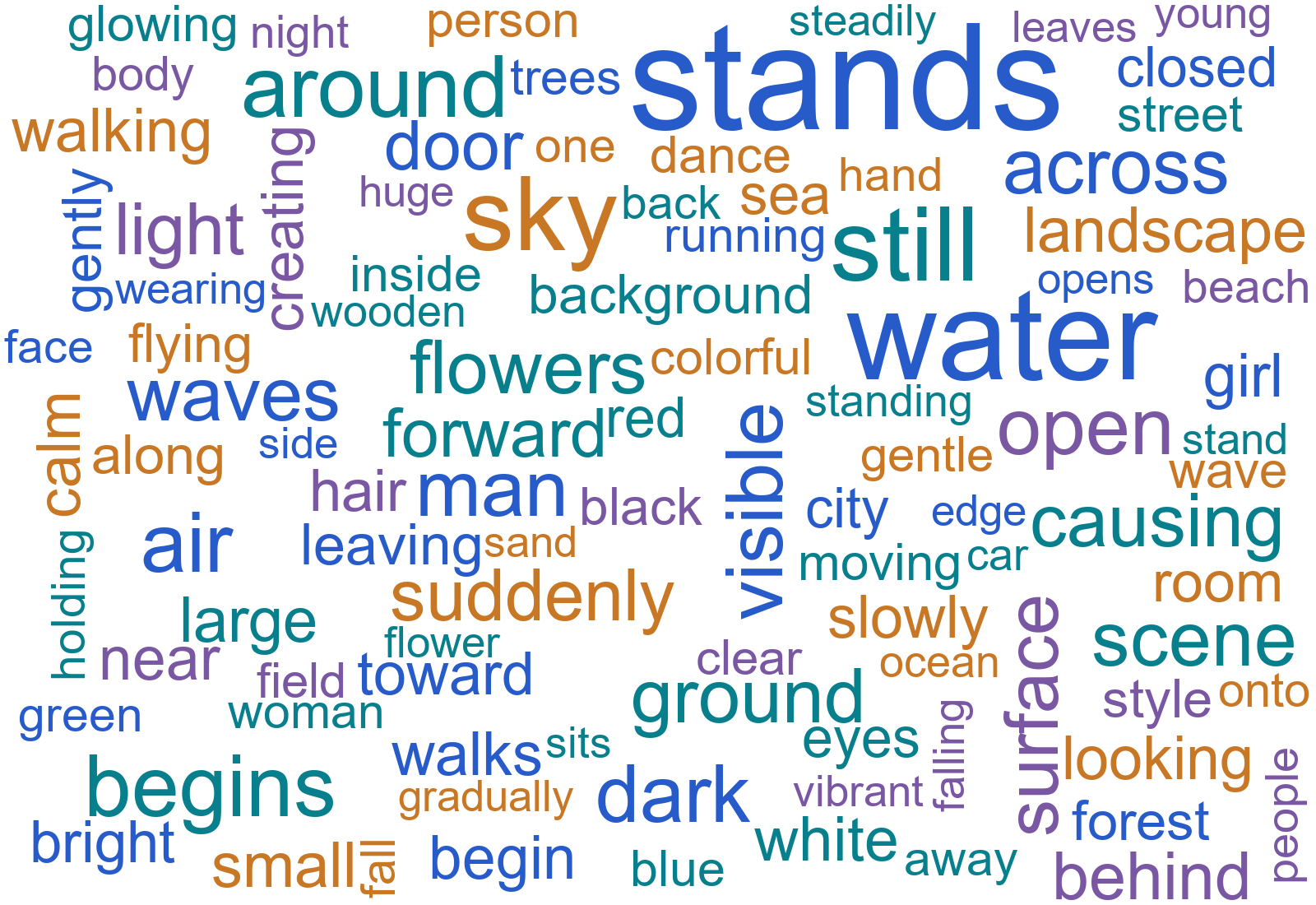
A task, made explicit
Judgments use visible evidence only. The generation prompt supplies context for VLD, not evidence. Each WPV window may support several phases or none.
For failure questions, YES means the failure is visible; NO means it is not visible. This polarity is opposite to a successful quality or phase judgment. The prompts below are instantiated for the currently selected task; each returned label must be one of YES, PARTIAL, or NO.
Main-paper results
Agreement with the human reference and direct full-video comparisons test different aspects of evaluation. Cross-VLM consistency alone does not establish human-aligned assessment.
150 matched videos from 50 tasks. Each entry is Kendall's τb / Spearman's ρ. Correlations are computed across individual videos, not generator means.
All three VLMs correlate positively with human ratings, but no evaluator is strongest across every phase. Progression is less consistently judged.
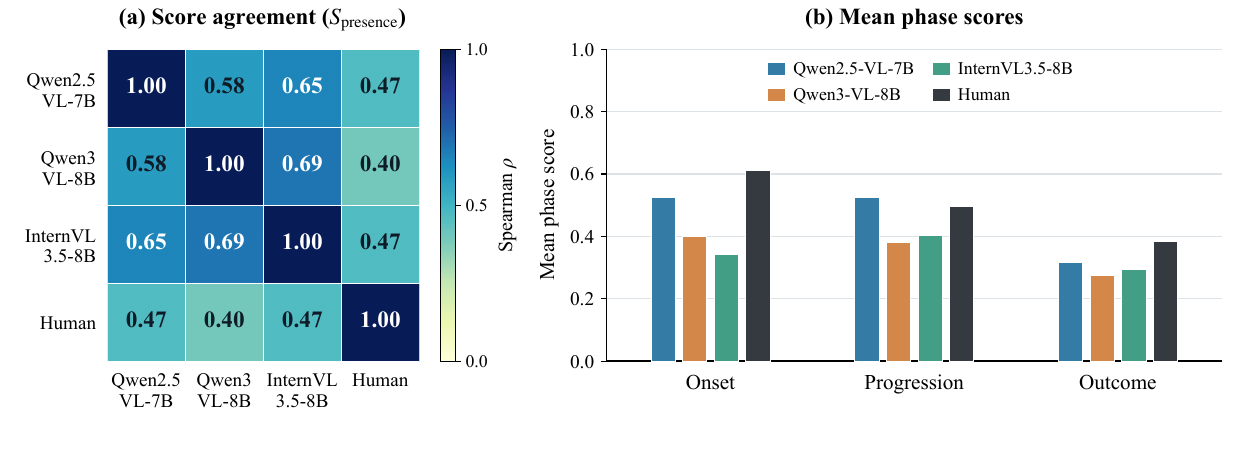
Direct full-video VLM assessment compared with OETGEval's four-window phase verification and ordered matching. Values follow the updated main-paper comparison.
OETGEval has the strongest human alignment among the compared evaluators on this evaluation. This supports the usefulness of explicit phase verification; it does not establish perfect or frame-exact temporal understanding. AUROC is a ranking measure, not classification accuracy.
Main-paper results
Producing visible activity remains easier than completing the specified transition. Outcome is the weakest phase for all three evaluated pretrained generators.
Baseline event evaluation: 50 matched tasks per generator, 150 videos total, 81 frames at 16 FPS. Full VBench quality is evaluated separately. Bold values mark the best pretrained-generator values within a column, not statistical significance.
Self-Forcing has the highest baseline Event Transition Score, but its advantage over CausVid is not resolved by the paired confidence interval.
Causal Forcing++ ranks highest on the consistency summary but lowest on Event Transition Score; Self-Forcing shows the reverse ranking.
These observations support evaluating event completion separately from visual consistency, without establishing a causal trade-off.
TC is the equal-weight mean of subject consistency, background consistency, temporal flickering, and motion smoothness on the same matched videos. It is not an official VBench aggregate; its absolute scale is not directly comparable with Event Transition Score.
A small post-training study
We investigate whether OETGEval feedback can guide model improvement through anchor-relative feedback and positive-advantage gating.
Cumulative configurations share a fixed event scorer, four policy rollouts per prompt, and identical group normalization and advantage clipping. Values are from the current main-text A1–A4 table.
Phase/order weighting alone offers limited improvement. Anchor-relative penalties reduce measured failures but also lower VLD Quality. Adding the gate gives the strongest event, outcome, and quality scores, while the ungated penalized variant retains the lowest failure score. The result supports gating as a complement to penalties, not as a guarantee that every quality dimension improves.
The gate filters positive sample advantages without subsequent renormalization. It does not certify post-update model quality. The separate post-training reference in the generator table is not pooled with the pretrained matched-video cohort.
Page data could not be loaded. Please reload this page through the local or hosted web address.